Call: 08045804103
 Send Inquiry
 Send Inquiry
Kojic Acid Dipalmitate
Price 1.0 INR/ Kilograms
MOQ : 1 Kilograms
Kojic Acid Dipalmitate Specification
- Other Names
- Kojic Acid Dipalmitate
- Storage
- Dry Place
- Form
- Powder
- Purity
- 99%
- Chemical Name
- Kojic Acid Dipalmitate
- Grade
- Other
- Standard
- COSMETIC
- Usage
- In cosmetic formulations, Kojic Acid Dipalmitate is typically used at 1% to 5%. For skin-brightening creams, lotions, and serums, usage levels generally range from 1 3%. In intensive treatment products targeting uneven skin tone and hyperpigmentation, concentrations of 3 5% may be used, subject to local regulatory requirements. The ingredient is usually incorporated into the oil phase of emulsions and should be heated sufficiently to ensure complete dissolution. The exact usage level should be determined through formulation development, stability testing, and efficacy evaluation.
- Main Material
- Kojic Acid Dipalmitate
- Application
- Other
Kojic Acid Dipalmitate Trade Information
- Minimum Order Quantity
- 1 Kilograms
- Delivery Time
- 1 Week
About Kojic Acid Dipalmitate
Kojic Acid Dipalmitate is a stabilized, oil-soluble derivative of kojic acid produced by esterifying kojic acid with palmitic acid. It appears as a white to off-white crystalline powder and is widely used in cosmetic and personal care products for its skin-brightening and complexion-enhancing properties. Compared to kojic acid, Kojic Acid Dipalmitate offers superior stability against heat, light, and oxidation, making it easier to incorporate into cosmetic formulations. The ingredient helps promote a more even skin tone by reducing the appearance of hyperpigmentation, age spots, sun spots, and post-inflammatory discoloration. It is commonly used in products designed for skin brightening, anti-aging, and overall complexion improvement. Kojic Acid Dipalmitate is compatible with a variety of oils and emollients and is frequently incorporated into creams, lotions, serums, gels, masks, and specialty treatment products. Due to its oil solubility, it can be effectively formulated in both emulsion and anhydrous systems. The ingredient contributes to a smoother, brighter, and more radiant-looking complexion while supporting the overall aesthetic quality of skincare formulations.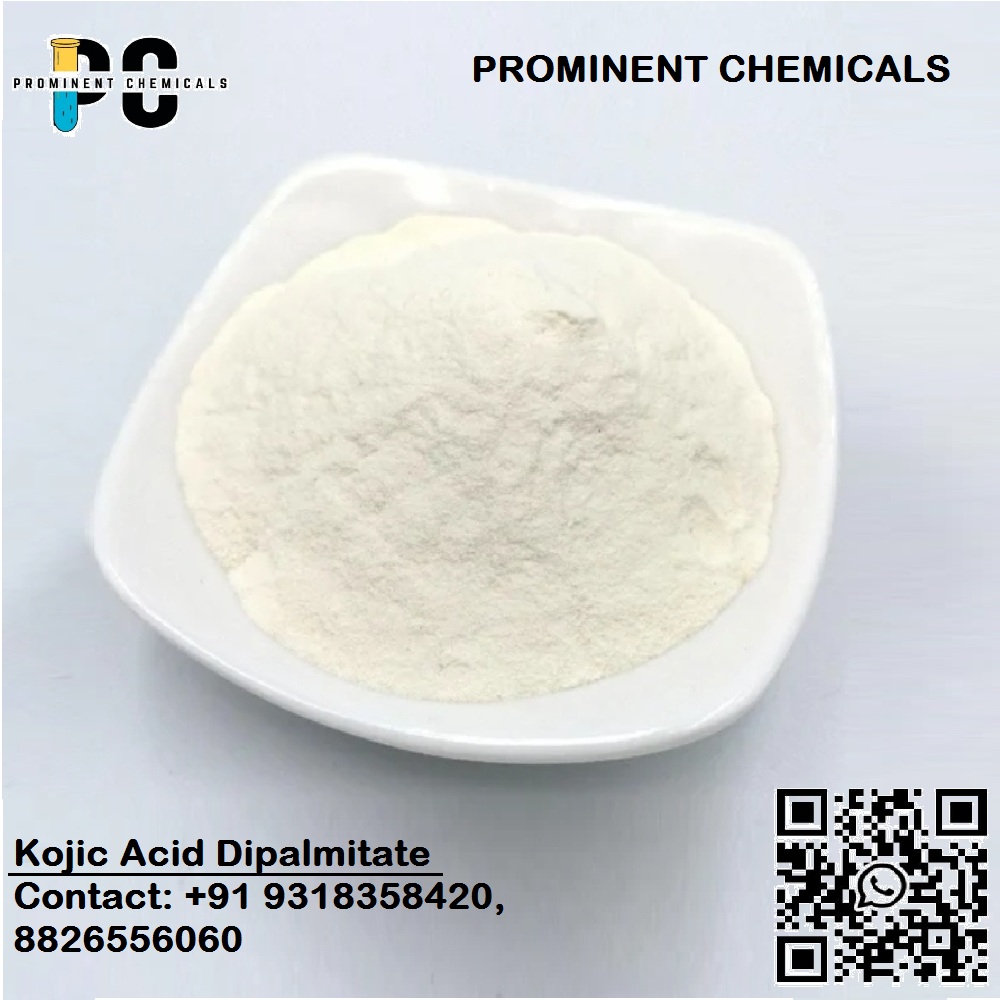
Tell us about your requirement

Price:
Quantity
Select Unit
- 50
- 100
- 200
- 250
- 500
- 1000+
Additional detail
Mobile number
Email

More Products in SKIN CARE Category
PRO BG (BUTYLENE GLYCOL)
Minimum Order Quantity : 1 Kilograms
Grade : COSMETIC GRADE
Usage : Industrial
Storage : Room Temperature
Application : Other
PRO 245 (CYCLOPENTA SILOXANE)
Minimum Order Quantity : 1 Kilograms
Grade : Industrial Grade
Usage : Industrial
Storage : Room Temperature
Application : Other
ISCA GUARD PEG
Price 1.0 INR / Kilograms
Minimum Order Quantity : 1 Kilograms
Grade : Other
Usage : Iscaguard PEG is typically used at 0.4% to 1.0% in cosmetic and personal care formulations. In creams, lotions, serums, and other leaveon products, recommended usage levels generally range from 0.4 1.0%. In shampoos, shower gels, facial cleansers, and other rinseoff products, it is commonly used at 0.4 1.0%. The preservative is effective over a broad pH range and is usually added during the cooling phase of formulation, generally below 40 50 C, to maintain optimal performance. The final dosage should be confirmed through preservative efficacy testing and stability evaluation of the finished product.
Storage : Dry Place
Application : Other
ISCA GUARD PFA
Price 1.0 INR / Kilograms
Minimum Order Quantity : 1 Kilograms
Grade : Other
Usage : In cosmetic and personal care formulations, Iscaguard PFA is typically used at 0.5% to 1.5%. For creams, lotions, serums, and other leaveon products, recommended usage levels generally range from 0.5 1.0%. In shampoos, shower gels, facial cleansers, conditioners, and other rinseoff products, usage levels of 0.5 1.5% are commonly employed. It performs effectively within a pH range of approximately 4.0 9.0 and can be added during manufacturing at temperatures up to 80 C, although prolonged heating is not recommended. The final dosage should always be confirmed through preservative efficacy testing, stability studies, and compatibility evaluation of the finished formulation.
Storage : Dry Place
Application : Other

Contact Details
PROMINENT CHEMICALS
GST : 07AOUPY9794F2ZM
- Shop No. - 3 & 4, 1 G.T karnal Road Industrial Area, Opp. Gujrawala Town 1st,Delhi - 110033, India
- Phone :08045804103
 Send Inquiry
Developed and Managed by Infocom Network Private Limited.
